When Guillermo del Toro set out to achieve his life-long dream of bringing Frankenstein to life,
the behind-the-scenes story demanded a level of craft on par with the film itself.


We weren’t just cutting a behind-the-scenes documentary – been there, done that. This project would be an exercise in building a searchable, collaborative post-production infrastructure that could handle Hollywood-scale media while maintaining the flexibility to pivot as creative needs came to life.
Prefer to watch and not read? Click here to see the documentary on Netflix.

In early 2024, Sawtooth Post was approached by documentary producer and filmmaker Javier Soto to edit the making-of documentary for Guillermo del Toro’s adaptation of Mary Shelley’s Frankenstein for Netflix.
The scope? A 45-minute documentary titled The Anatomy Lesson, multiple cutdowns, plus six additional featurettes for marketing and Awards campaigns.
The scale? Over 34 terabytes of footage spanning more than 100 days of principal photography and 60+ multicam interviews.

Cathedral-Sized Challenges
Summing up how a film of this magnitude was crafted over a year and across continents would be no easy task, but a few unique hurdles made Frankenstein’s BTS work especially complex.


The Missing Pieces
One of the biggest challenges? Key interviews from Creature actor Jacob Elordi and Guillermo del Toro himself wouldn’t arrive until midway through summer 2025. As you’d expect, GDT serves as the documentary’s narrative backbone, connecting departments, people, and thoughts. His early absence required careful planning to navigate.
Lead Editor Chris Salters’ solution was to craft the documentary using other interviews while leaving strategic placeholders for specific questions we knew Guillermo and Jacob could answer. Think of it as building a cathedral without the cornerstone – you know exactly what needs to go where and build a structure that can hold the supports.


When Elordi’s interview finally happened, it came with constraints: 20 minutes or less (actors are busy!) and captured on green screen. Producer Scott Stuber‘s interview faced similar VFX challenges. Rather than settling for mismatched visuals, Sawtooth created clean background plates for each interview using Photoshop’s Generative Fill. The result matched the doc’s aesthetic perfectly – a small but crucial detail that kept the visual language consistent.
What About Watermarks?
As with most entertainment work dealing with unreleased features, Sawtooth initially had to work with watermarked, low-resolution versions of Frankenstein. Anticipating what could be a nightmare of overcutting work once the film’s clean master arrived, the team planned ahead and built a UHD nested sequence used throughout the doc and featurettes.
When the final master arrived it was simply dropped into that nested sequence and checked against the watermarked version using a difference blending mode. Overcutting done, instantly. No manual match framing. No hunting for timecode. Preparation paying dividends.

Dark Imagery, Sony, Red RAW, and Reality
Guillermo and Javier favor dark, moody imagery, which presents a challenge for BTS camera operators working in practical locations. The behind-the-scenes footage came from a mix of Sony FS7 and Red cameras. The Sony footage required minimal color massaging to minimize noise in dark areas, but the Red RAW worked flawlessly. The only caveat? Again, the sheer volume of footage.
Sawtooth originally planned to edit the entire Frankenstein BTS project in a Premiere Pro Production, but opening a project with the massive amount of segmented Red files took ages. The solution? Moving both offline and online editorial into DaVinci Resolve 20. The switch saved the day, offering rock-solid performance and making remote collaboration nearly effortless thanks to Blackmagic Cloud.
Storage: It’s Gotta Be Big, It’s Gotta Be Fast
For a project of this scale, storage will either enable creativity or hamper your efforts. There’s no in-between.

Sawtooth deployed a 48TB RAID 10 NAS configuration dedicated to the Frankenstein project, providing the speed necessary to handle 4K and 6K footage while maintaining redundancy for drive failure and keeping separate storage options available for brand and advertising work over the year-long course of the project. 10-gigabit connections kept media flowing quickly across multiple edit bays. One notable detail: the NAS is sandboxed on a secure internal network, critical when working with unreleased Hollywood content, but a proxy workflow within DaVinci Resolve let local and remote editors crank on the project simultaneously with ease.
Remote Work Without Compromise
Proxy footage was handed to remote editors as needed with a folder structure mirroring the main storage unit. Using Blackmagic Cloud for project hosting, DaVinci Resolve simply loaded files as if all 34TB were accessible locally. Remote editors could even export using proxies while final delivery happened at Sawtooth headquarters. LucidLink was tapped as a high-speed file transfer service for moving large color files and final deliverables as needed.
No VPN headaches. No file conflicts. Seamless collaboration at its best.
Making 100+ Days of Footage Searchable
If you have it but can’t find it, do you really have it?
At Sawtooth, we believe you gotta “Fix it in Prep so you can Flex it in Post” and that mantra proved essential here. The team spent the early phase of the project meticulously logging every clip using DaVinci Resolve’s robust metadata system. Every single clip across 100+ days of shooting was tagged with:
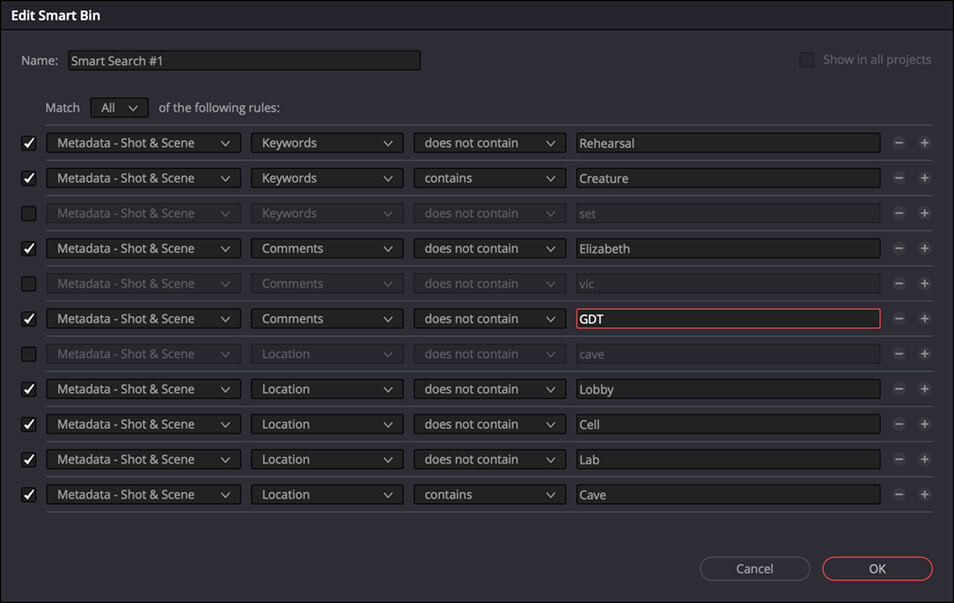
- Keywords: Single words for major themes(Costumes, Makeup, Cinematography, etc.)
- Comments: Important characters and crew that appear (using character names)
- Location: Script scene locations matching bin structure
- Description: Basic action in the clip, in relation to the film’s script

This level of organization wasn’t overkill – it was necessary. And it would save the day as delivery timelines accelerated. Custom search bins allowed the editorial team to quickly locate specific moments across a mountain of media. Need all clips featuring Elizabeth and Victor together? Maybe some with GDT? And only in the lab? With a few clicks, they’re located instantly.
AI: The New Post-Production Assistant
Beyond standard transcription, Sawtooth leaned into AI tools that genuinely enhanced the workflow without replacing editorial instinct.
DaVinci Resolve’s AI transcription has improved immensely, and Sawtooth utilized it extensively for interview searchability.
Google’s Notebook LM became the real game-changer beyond AI-transcription. By loading the film’s script and all interview transcripts into a secure project, the team could ask context-based questions and get relevant answers instantly:

“List all locations in the film where the Creature and William are seen together.”
“Does Oscar Isaac discuss his feelings towards Jacob Elordi’s performance as the Creature?”
“Show bites from Guillermo discussing aging sets.”
Notebook LM surfaced the right material faster so editors could focus on editing, not hunting, which accelerated addressing client notes or sourcing soundbites.
ElevenLabs was the final tool in Sawtooth’s AI toolbox. We’re believers in telling a true story, not putting words in people’s mouths. Rather than cutting together the perfect sentence via frankenbites (ironically named in this case), ElevenLabs was deployed to craft the perfect soundbite via correcting mumbles or bridging thoughts to move the doc’s narrative forward, while maintaining authenticity.
Emotional Engineering: Crafting the Narrative
Early in pre-production, Sawtooth worked with producer Javier Soto to define the documentary’s major themes. With those pillars and the film itself as guides, the team crafted a narrative blueprint giving the story its flow. For this project, the documentary shaped around four core themes:

1. The Journey
• A dream, years in the making
• Built on every film before it
• Assembled with a world-class team
2. Building Worlds
• Global-scale sets
• Meticulous production design
• Cinematography as the unifier
3. Invisible Alchemy
• Story-shaping in the edit
• Unique digital effects
• Score and elevated sound
4. Vision Realized
• Cast and crew reflections
• Expectations vs reality
• The audience takeaway

The team created rough selects sequences for each chapter and began populating them with relevant bites. Threads connected quickly, ideas became through-lines, and the story shaped itself in a systematic manner. When key interviews were still missing, we’d drop placeholders and keep moving. Experienced editors adapt to what’s coming, not just what’s already there.
Scaling Up When It Counts

Without the meticulous prep work at the beginning of the project, the accelerated delivery timeline would have been impossible to meet. That organization enabled Sawtooth to onboard additional editor Mitch Martin and have him addressing meaningful notes to the doc in less than a day. The structured ingests and detailed metadata logging in DaVinci meant he could navigate 34TB of footage as if he’d been on the project from day one.
Motion graphics artist Samuel Levesley-Turner and VFX artist Marios Kourasis would round out the team to help power through the accelerated timeline, while color grading was handled by Gabe Diaz and audio finishing by Michael Jesmer and Mike Greenberg.
The Results
The Anatomy Lesson and its companion featurettes delivered to Netflix in September 2025, ahead of the film’s October 17th theatrical and November 7th platform release dates.

This making-of documentary and its visuals are crafted with purpose, not just blanketed with coverage. The doc is a film in itself – something you can watch with the sound off, or listen without visuals, and still walk away with an understanding of how this masterpiece was painstakingly crafted. Sawtooth Post, under Javier Soto’s guidance, cut a detailed documentary showcasing the filmmaking artistry and lifelong passion that Guillermo and his team invested in this project.
Fix It in Prep, Flex It in Post
Whether editing on set, cutting documentaries, or building brand films, the principle remains: invest the time upfront to organize, structure, and prepare. The creative freedom that follows is worth every meticulous minute.

Project Highlights:
- 1x 45-minute documentary (The Anatomy Lesson) + cutdowns
- 3x Marketing featurettes
- 2x Awards campaign featurettes
- 34TB+ of footage
- 100+ days of principal photography coverage
- 60+ multicam 6K interviews
- Timeline: June 2024 – November 2025

Team:
- Javier Soto: Producer (Javier Soto Productions)
- Chris Salters: Lead Editor, Post Supervisor, Workflow Design
- Mitch Martin: Additional Editor
- Samuel Levesley-Turner: Motion Graphics
- Marios Kourasis: VFX
- Gabe Diaz: Color
- Michael Jesmer & Mike Greenberg: Audio Finishing